
Why this matters now
If your name is on something that really belongs to someone else, you may have to file a trust return with the CRA for 2026. The first filing is due March 31, 2027.
These rules have been delayed several times since they were announced in 2018. Many people stopped paying attention. But 2026 is the first year the rules are actually in force, and late filing carries penalties.
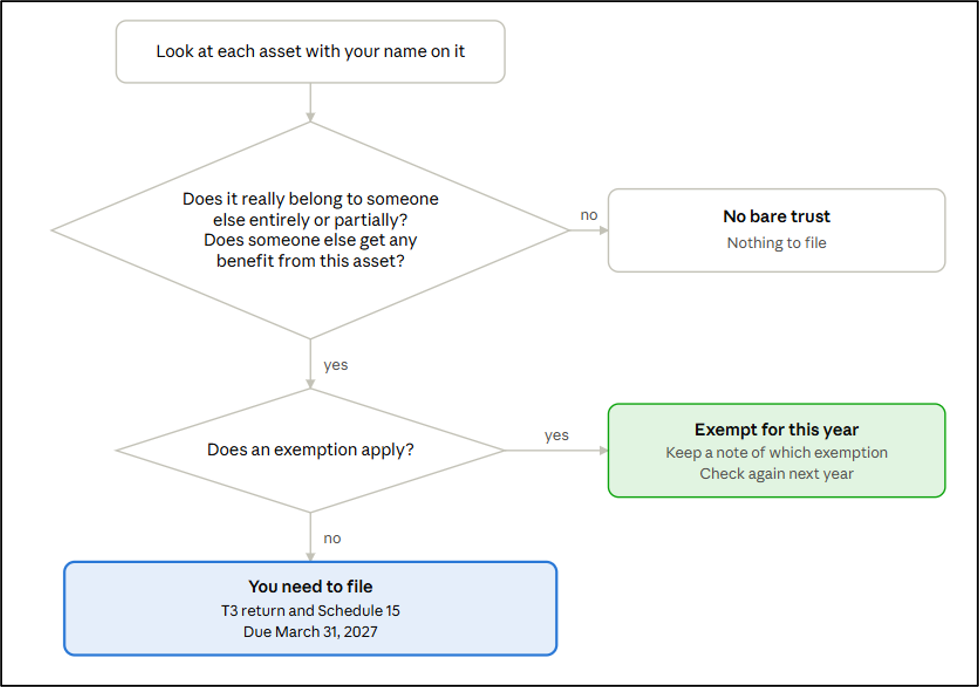
The good news: many arrangements are exempt. This guide walks you through a simple checklist and flowchart so you can see where you stand before you talk to us.
What is a bare trust?
A bare trust exists when one person’s name is on an asset, but the asset really belongs to someone else. The name on title is the legal owner (the “trustee”). The person it really belongs to is the beneficial owner.
The legal owner has no real say. They just hold the title and do what the beneficial owner tells them. No lawyer or written agreement is needed for a bare trust to exist. Many people have one without knowing it.
To spot one, ask two questions:
- Whose name is on it? The bank account, the deed, the share certificate, the vehicle registration.
- Who really owns it? Who paid for it, uses it, pays its costs, keeps the income, and gets the money if it is sold?
If the answers are different people, you likely have a bare trust.
Checklist: does any of this sound like you?
Tick anything that applies, even if you are not sure. We will sort out the details together.
Homes and real estate
- A parent is on a child’s home title to help get a mortgage.
- A child is on an aging parent’s home or cottage title for estate or probate planning.
- One spouse is on title, but both spouses own the home.
- A company or person holds land or a building on behalf of the real owner (a “nominee”).
- Foreign property is held in someone else’s name because of local law (for example, a Mexican bank trust).
Bank accounts and investments
- An account is held “in trust for” a child or grandchild.
- An adult child was added to a parent’s bank account to help pay bills.
- A joint account, GIC or brokerage account is in your name but holds someone else’s money.
- Shareholders opened a bank account in their personal names that really belong to their company.
Business and corporate
- A company holds a vehicle, equipment or investments for a shareholder or a related company.
- Shares are held by someone only to meet director or governance rules.
- A partner or joint venture operator holds assets for the whole group.
- A company holds a lease, or a bank account, on behalf of another company or clients.
- Cash is held back in escrow on a sale.
Other assets
- A car, boat or plane is registered to a parent or business, but someone else pays for it and uses it.
- Art or collectibles are registered in an agent’s name for privacy.
- A lawyer holds a specific trust account for you with more than $250,000.
Note: acting under a power of attorney does not, by itself, create a bare trust. Being added as a signer on an account can.
Flowchart: do I need to file?
The exemptions, in plain English
You do not have to file if any one of these applies for the whole year.
| Exemption | You are exempt if… |
| Under $50,000 | The assets were worth $50,000 or less at all times during the year. |
| Under $250,000, simple assets | The assets were worth $250,000 or less and included none of these: gold, silver, commodities, private company shares, or shares of partnership, private loans, mortgages or crypto. |
| Short-lived | The arrangement existed for less than 3 months. |
| Everyone on title also owns it | Every person on title is also a true owner in the year. |
| Family home | Everyone on title is a related individual (including aunts, uncles, nieces and nephews), and one of them could claim the home as a principal residence. |
| Spouses | One spouse is on title of the home and the other spouse is a beneficial owner. |
| Lawyer’s general trust account | The money sits in a lawyer’s pooled client account. |
| Lawyer’s specific account | The account holds $250,000 or less, only in cash, term deposits or GICs. |
| Partnerships | A partner holds the asset for the partnership, the partnership files a T5013 return, and everyone on title is a partner. |
Watch out: your status can change from year to year. An account that grows past $50,000, or a new asset like crypto, can make you lose an exemption. Check every year.
If you do need to file
The person whose name is on title (the trustee) files, not the true owner. Filing is mostly paperwork; no tax is usually owing. It involves:
- Getting a trust account number from the CRA.
- Filing a T3 trust return, with all the dollar lines left blank.
- Filing Schedule 15, which lists everyone involved: the trustees, the true owners, anyone who put money in, and anyone who controls the trustee.
We can handle all of this for you. If a T3 was already filed for 2023 we likely already have some or all of this information, which makes this year easier.
Penalties for late or missing filings:
- $25 per day, with a minimum of $100 and a maximum of $2,500.
- If the CRA finds the failure was deliberate or grossly negligent: the greater of $2,500 or 5% of the value of the property. On a $1 million home, that is $50,000.
- Penalties are charged to the trustee, the person on title.
What to do next
- Go through the checklist above and tick anything that might apply.
- Note whose name is on the asset, who really owns it, and roughly what it is worth.
- Gather any written agreements or trust declarations, if you have them. Don’t worry if you don’t.
- Contact us immediately, so we can confirm whether an exemption applies or file for you.
Disclaimer: Every situation is different, and the exemptions depend on the facts. This article is general information, not advice for your specific situation. Please reach out and we will review your arrangements with you.